
Skip to content

Industrial Process Water Reuse with Plasma Oxidation

Reuse suitable process water by controlling microbial activity and dissolved organic contaminants in recirculating water systems. VuOxi Plasma Oxidizer uses non-thermal plasma oxidation to treat process water continuously, supporting reduced freshwater intake and wastewater generation.

Why reuse industrial process water?

Industrial processes often use large volumes of water for cooling, washing, dilution and other operations. Treating and recirculating suitable process water can reduce freshwater intake and wastewater generation.

The challenge is maintaining water quality as the same water is circulated through the process.

  • Reduce freshwater intake
    Reuse suitable process water instead of continuously replacing it.
  • Reduce wastewater generation
    Keep more water within the process loop and reduce the volume requiring discharge.
  • Control microbial activity
    Manage biological growth in recirculating water systems.
  • Reduce chemical dosing
    VuOxi Plasma Oxidizer operates using electricity rather than conventional oxidant dosing.

What makes process water difficult to reuse?

  • Microbial activity
    Can contribute to biofouling, corrosion and hygienic risks.
  • Dissolved organic contaminants
    Can accumulate during recirculation and affect water quality and reuse potential.
  • Suspended solids
    Can contribute to fouling and clogging and may require upstream separation.
  • Water hardness
    Can cause scaling and may require dedicated hardness control.
mikko-nikkinen_h1i0745

How does plasma oxidation support process water reuse?

VuOxi Plasma Oxidizer uses non-thermal pulsed corona discharge to generate reactive oxidizing species from electricity, ambient air and water. These reactive species can control microbial activity and oxidize dissolved organic contaminants in recirculating process water.

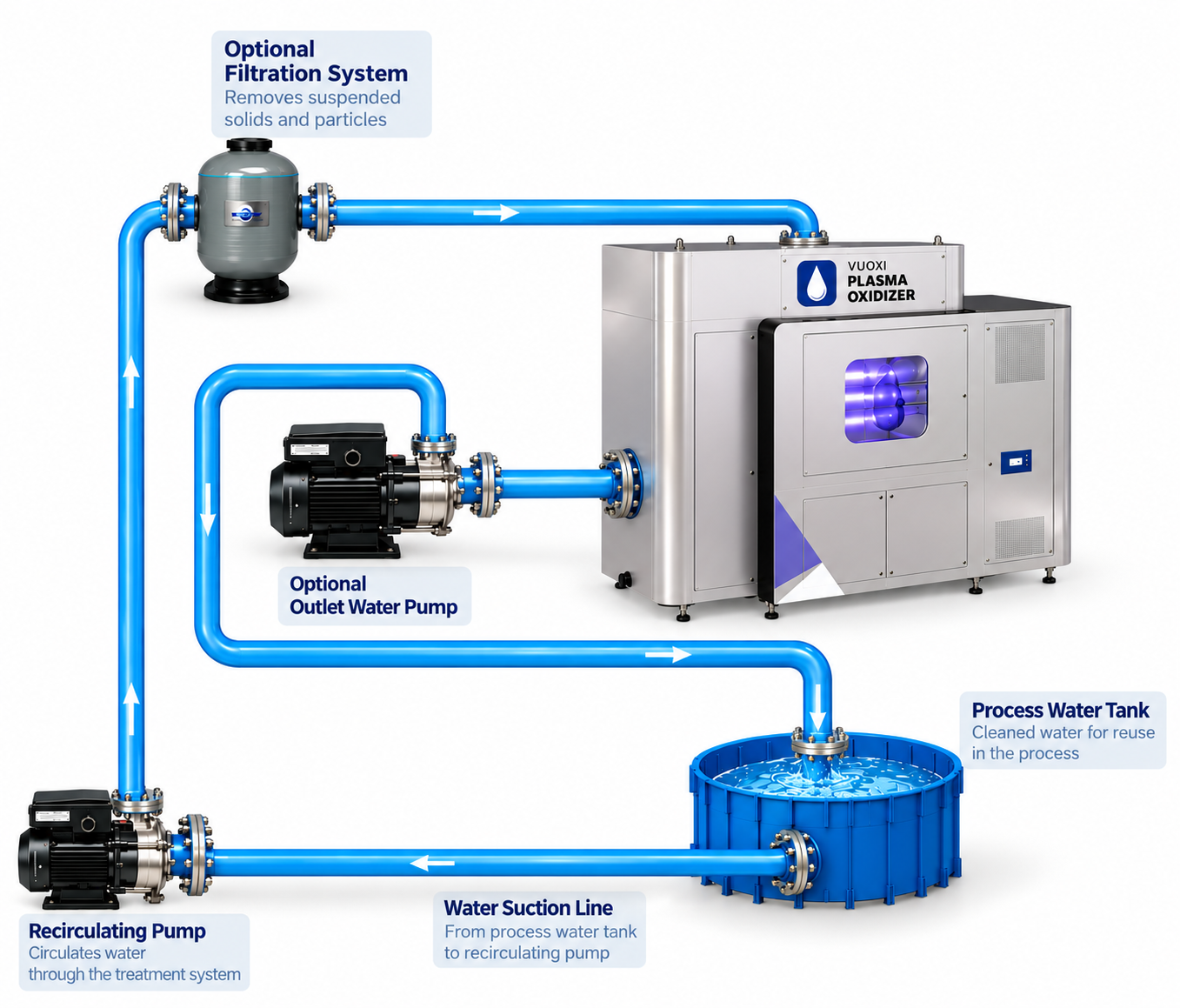
The treatment can be integrated into a recirculating water loop, allowing suitable process water to be treated continuously before being returned to the process.

Where can treated process water be reused?

  • Cooling water
    Recirculating water used in cooling systems and heat-transfer processes.
  • Washing water
    Suitable treated water for industrial washing and cleaning applications.
  • Process water
    Water reused within the same or another step of the production process.
  • Other non-potable uses
    Application-specific reuse opportunities depending on water quality requirements.

Microbial control in recirculating process water

Microbial growth is a major challenge in recirculating process water. Microbes can grow on surfaces such as tanks, pipes and heat exchangers, contributing to biofouling, corrosion and reduced process efficiency. Biological growth can also limit opportunities to reuse process water for applications such as washing and cooling.

  • Biofouling and deposits
  • Corrosion
  • Reduced process efficiency
  • Limitations on water reuse
process-chart2

Eliminate microbes without chemicals

VuOxi Plasma Oxidizer uses non-thermal plasma oxidation to control biological growth in process water. The process generates reactive oxygen and nitrogen species (RONS) from ambient air and water using electrical energy. These reactive species can inhibit microbial activity in recirculating water systems.

  • Low-maintenance and automated
    Designed for continuous operation with a high level of automation.
  • Electricity-based treatment
    The process uses electrical energy rather than dosing conventional oxidants into the water.
  • No conventional chemical dosing
    There is no need to purchase, store and feed conventional oxidants into the process water.
  • No chlorinated byproducts from chlorinated dosing
    Because conventional chlorinated oxidants are not dosed into the process water, their associated chlorination byproducts are not generated by that dosing step.

By controlling microbial activity, plasma oxidation can support the continuous recirculation and reuse of suitable process water.

Reusing process water can reduce freshwater intake, wastewater generation and associated water-management costs.

How is a process water reuse application evaluated?

The suitability of process water for reuse depends on the water quality, contaminants, process requirements and intended reuse point. VuOxi evaluates the water and the treatment target before selecting the appropriate treatment approach.

1. Water characterization
Identify key water-quality parameters and contaminants.

2. Laboratory testing
Evaluate plasma oxidation against the relevant treatment targets.

3. Pilot testing
Test treatment under representative process conditions when required.

4. Reuse assessment
Determine whether treated water meets the requirements of the intended reuse application.

testing1

What can plasma oxidation address in process water?

Water quality challenge Examples What plasma oxidation does
Microbial activity Bacteria, fungi, algae and biological growth Helps control microbial activity and biological growth
Dissolved organic contaminants Dissolved organic compounds and process-specific contaminants Oxidizes and degrades dissolved organic compounds
Residual organic compounds Organic compounds that accumulate during water recirculation Can oxidize organic compounds and support water quality control
Biofouling-related water quality issues Biological deposits and microbial growth on wetted surfaces Controls microbial activity that can contribute to biological growth
Application-specific organic contaminants Contaminants associated with specific industrial processes Can oxidize target organic compounds depending on the water matrix and treatment conditions
Water quality degradation during recirculation Accumulation of microbial and dissolved organic contaminants Supports continuous treatment and reuse of suitable process water

Treatment performance depends on the specific water matrix, target contaminants, concentrations and operating conditions. Laboratory or pilot testing may be required to determine suitable treatment conditions and verify the intended reuse application.

Could your process water be reused?

Tell us about your current water use, treatment system and intended reuse application. We can assess whether plasma oxidation could be suitable for your process.